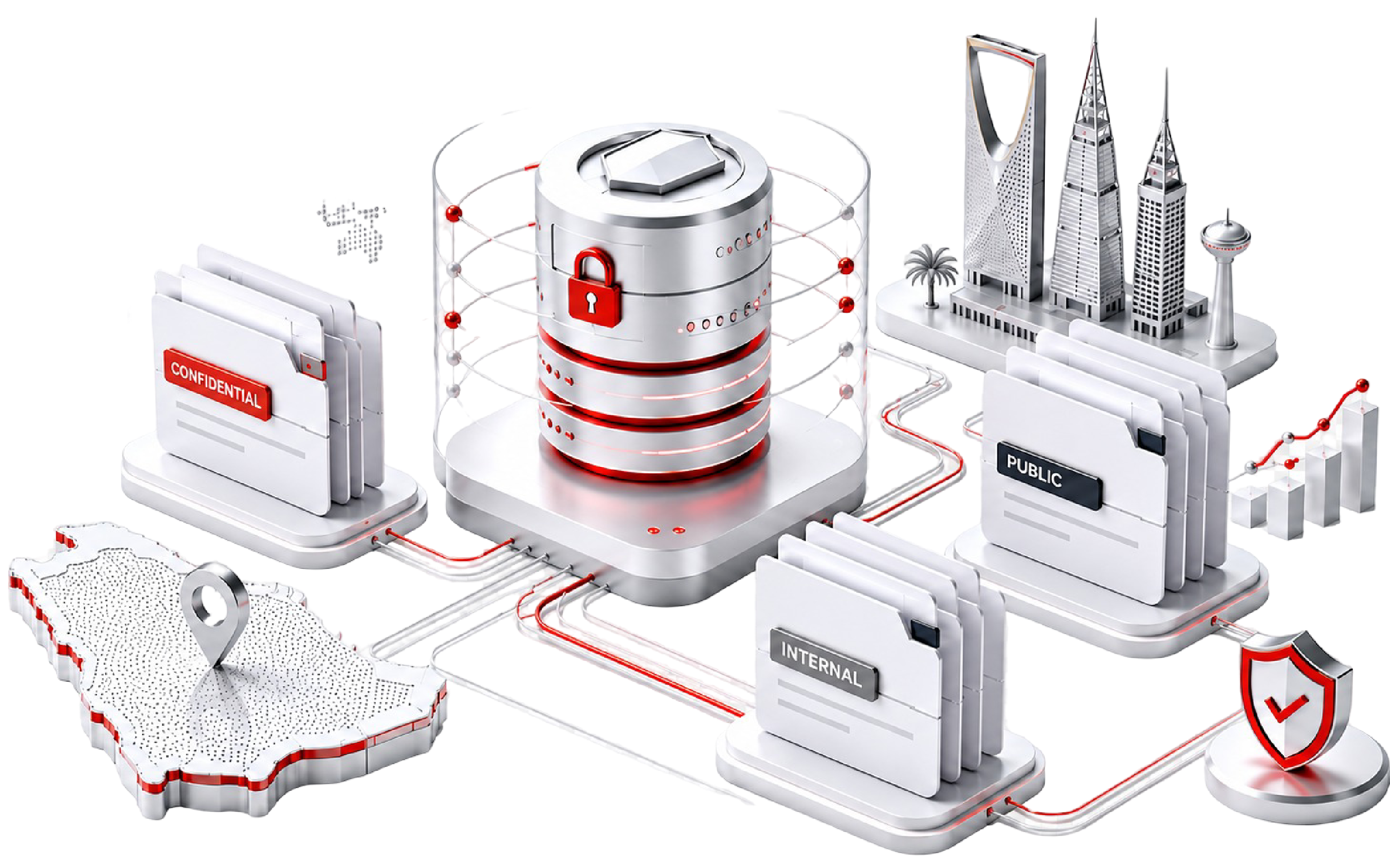
Data Classification Framework
Define practical classification levels, criteria, ownership, and handling requirements based on information sensitivity and business risk.

SecureLink helps organizations identify, categorize, and label information based on its sensitivity, business value, risk, and applicable requirements. Our data classification services help establish practical classification frameworks, improve data visibility, strengthen information handling controls, and support effective data governance across business operations and technology environments.
Effective data classification helps organizations identify, categorize, label, and manage information according to its sensitivity, business value, risk, and handling requirements. SecureLink helps organizations establish practical classification frameworks that support data protection, governance, and secure information handling.
Define practical classification levels, criteria, ownership, and handling requirements based on information sensitivity and business risk.
Assess information based on sensitivity, confidentiality, business impact, regulatory considerations, and potential security risks.
Establish consistent labels and categories so employees and systems can identify information according to its required protection level.
Map classification levels to practical controls for access, storage, sharing, transmission, protection, retention, and disposal.
Develop clear data classification policies, standards, procedures, and ownership responsibilities for consistent organizational use.
Connect data classification with data governance, access management, security controls, privacy requirements, and ongoing monitoring.
Organizations often hold large volumes of structured and unstructured information across applications, endpoints, cloud platforms, databases, and file repositories. Without a consistent classification approach, it can be difficult to determine what data is sensitive, how it should be handled, and which controls should apply.
SecureLink can help organizations identify classification gaps and establish consistent practices for categorizing, labeling, protecting, and managing information.
Our services help organizations identify, categorize, label, and manage information according to its sensitivity, business value, risk, and handling requirements. SecureLink connects data classification with practical governance and information protection controls.
Define classification levels, criteria, ownership, decision rules, and handling requirements based on information sensitivity and business risk.
Develop practical policies, standards, procedures, and guidance for consistently classifying and handling organizational information.
Assess information based on confidentiality, business impact, sensitivity, regulatory considerations, and potential security risks.
Establish clear data labels and handling requirements for access, storage, sharing, transmission, protection, and disposal.
Review existing classification practices, identify gaps, and assess how effectively sensitive and business-critical information is categorized.
Connect classification requirements with data ownership, access management, security controls, retention, and governance processes.
Review classification practices, changes, exceptions, and control effectiveness as business processes, systems, and data environments evolve.
Help employees understand classification levels, labeling requirements, and the appropriate handling of sensitive and business-critical information.
Effective data classification requires clear ownership, consistent classification criteria, documented handling requirements, and ongoing review. SecureLink helps organizations establish a practical framework for identifying, categorizing, labeling, and protecting information according to its sensitivity and business value.
Define data owners, custodians, responsibilities, approval roles, and accountability for classification decisions.
Establish documented classification levels, criteria, definitions, labeling rules, and information handling standards.
Review whether information is classified consistently and whether required handling controls are applied to each classification level.
Provide visibility into classification gaps, sensitive information risks, exceptions, remediation actions, and management priorities.
Refresh classification practices as business processes, applications, data repositories, technologies, and information requirements change.
Maintain traceable records of classification decisions, data owners, handling requirements, exceptions, reviews, and implemented controls.
A structured data classification approach helps organizations understand the sensitivity and value of their information, apply appropriate handling controls, and improve data governance across business and technology environments.
Improve understanding of where sensitive, confidential, personal, and business-critical information exists across the organization.
Use data sensitivity and business impact to identify which information requires stronger protection and focused risk management.
Establish consistent rules for accessing, storing, sharing, transmitting, retaining, and disposing of information.
Connect classification requirements with data ownership, policies, access controls, security practices, and governance processes.
Keep classification rules and handling practices aligned as business processes, systems, applications, and data environments evolve.
Build a clearer foundation for information protection, security reviews, governance activities, and applicable regulatory requirements.
Data Classification Services focus on categorizing and labeling information according to sensitivity, business value, risk, and handling requirements. The specialist services below address related but distinct data security, privacy, and compliance needs.
Identify, locate, and map sensitive and business-critical information across databases, applications, endpoints, cloud platforms, and file repositories.
Explore Data Discovery →Assess and improve organizational practices against applicable Saudi Personal Data Protection Law requirements and privacy obligations.
Explore PDPL Services →Establish broader privacy governance, policies, risk management, operational controls, and accountability for personal information.
Explore Data Privacy →Provide ongoing privacy oversight, advisory support, governance, escalation, monitoring, and reporting through a defined DPO function.
Explore DPO Services →Data classification requirements vary by industry, business process, information type, and risk profile. SecureLink helps organizations establish practical classification and handling approaches for sensitive, confidential, personal, and business-critical information.
Classify customer, financial, transactional, employee, and business-critical information according to sensitivity and required protection.
Support structured classification of patient, clinical, employee, operational, and other sensitive health-related information.
Establish classification practices for citizen, government, operational, confidential, and service-related information across public-sector environments.
Classify operational, engineering, technical, workforce, supplier, project, and commercially sensitive information across complex environments.
Classify application, customer, user, source-code, product, analytics, and other digital information across rapidly changing technology environments.
Develop consistent classification practices across business units, departments, applications, repositories, and distributed data environments.
SecureLink focuses on practical classification frameworks, clear data ownership, consistent labeling, defined handling requirements, and measurable implementation rather than generic data governance recommendations.
Our data classification approach considers the Saudi regulatory, organizational, and business environment when defining information categories and handling requirements.
Classification criteria are mapped to real business processes, information types, data owners, systems, and operational responsibilities.
We help organizations distinguish information based on sensitivity, business impact, confidentiality, and the level of protection required.
Effective classification requires coordination across information owners, security, IT, compliance, legal, records management, and business teams.
Classification recommendations are translated into practical policies, labels, handling rules, ownership responsibilities, and implementation priorities.
We help organizations review and refine classification practices as data environments, business processes, technologies, and information requirements evolve.
We begin by understanding your information environment, then move from data identification and sensitivity assessment to classification, implementation, and ongoing review.
Review relevant data sources, repositories, business processes, information types, ownership, systems, and existing classification practices.
Identify sensitive, confidential, personal, and business-critical information and assess its sensitivity, business impact, and protection requirements.
Establish classification levels, criteria, labels, ownership, handling requirements, policies, and practical implementation priorities.
Monitor classification practices, address gaps and exceptions, review control effectiveness, and update classification requirements as the data environment changes.
Discuss your data classification needs, sensitivity assessment, classification levels, labeling practices, handling requirements, and governance priorities with SecureLink's team.
Answers focused specifically on the scope, implementation, and governance of SecureLink's Data Classification Services in Saudi Arabia.